
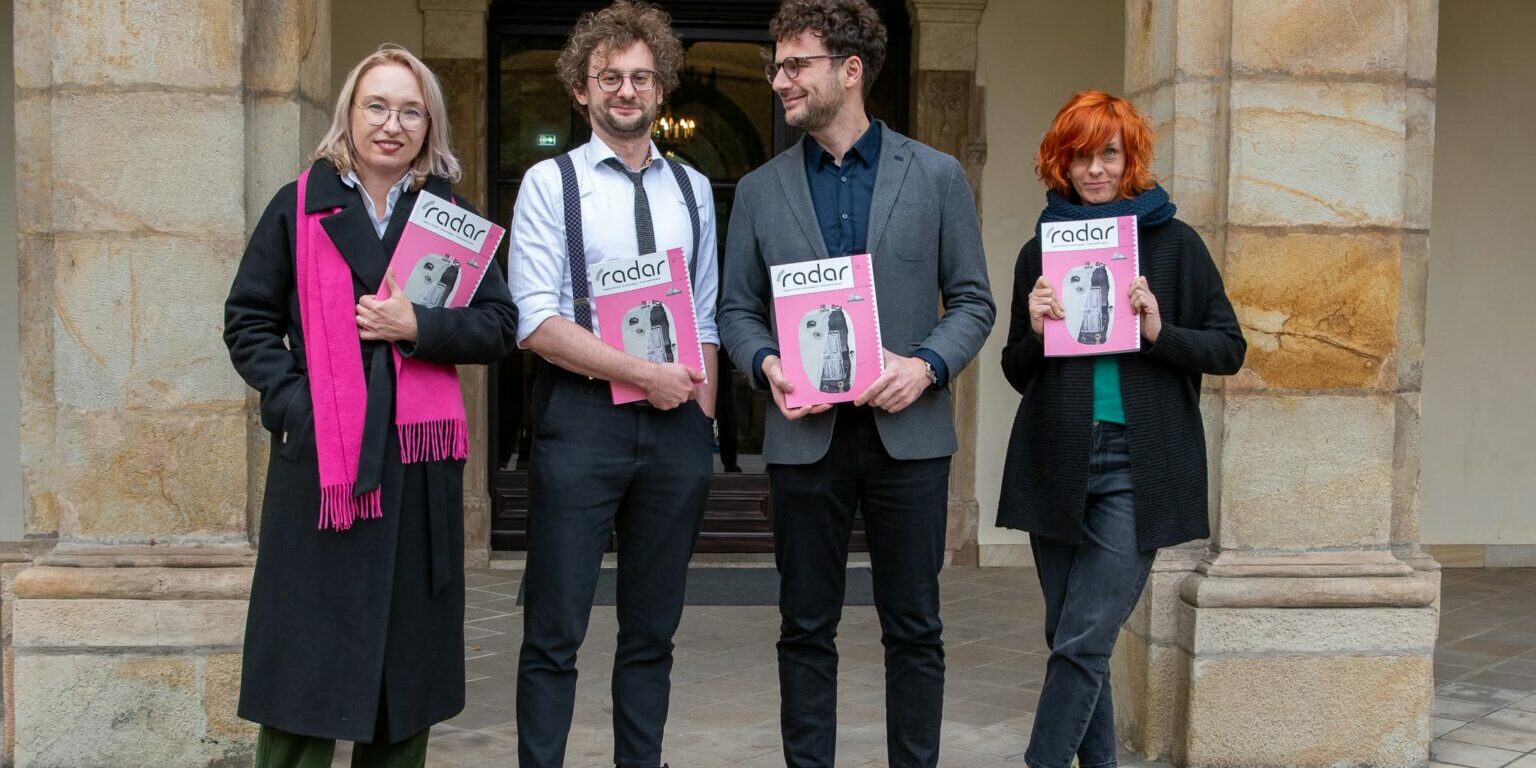
RADAR is a trilingual literary magazine – published in Polish, German and Ukrainian – edited and produced by the Villa Decius in Kraków. It is available both online and in a limited print edition.
RADAR is conceived as a platform for literary exchange and international cultural cooperation, bringing together writers, translators, editors and readers from Poland, Germany and Ukraine. Its mission is to strengthen cultural relations and literary circulation between the three countries, foster lasting connections between their literary communities, promote contemporary literature, and support both established and emerging authors and translators.
The magazine was originally published between 2010 and 2014 and was relaunched in 2023. It is now published twice a year – a summer issue launched during the Miłosz Festival, and an autumn issue presented during the Conrad Festival and the Kraków Book Fair.
The magazine is produced by an international editorial team and operates within a broad network of institutional and cultural partnerships. These include the German literary magazine “Edit” (Leipzig), the Goethe-Institut, the Book Institute, Lviv – UNESCO City of Literature, the Austrian Cultural Forum, the Polish Institute in Berlin, the Leipzig Book Fair and the Lviv Book Forum.
RADAR is presented in this Atlas as a case study of how cultural organizations can respond to changing political realities, technological developments and the growing need for cross-border cultural cooperation.
The original printed magazine ceased publication but was then revived in 2023 in its current format, which includes an online, multilingual platform: e-radar.online. It was brought back to life with a special trilingual edition, bringing together former authors, translators and Villa Decius residents. It showed how cultural projects can and should adapt to changing circumstances by searching for continuity, dialogue and the protection of artistic expression. This sometimes includes finding new forms of existence rather than disappearing when the original institutional or financial conditions change. Together with its international partnerships, this digital continuation transforms the magazine from a publication into an ongoing cultural network and space for transnational knowledge exchange.
Literature as a space of resistance
RADAR's continued existence is especially important because it has consistently created a space where literature can address questions of identity, memory, conflict, freedom and the future of Europe from transnational voices and perspectives. It does this instead of treating culture as something isolated from wider political developments.
At the same time, RADAR highlights the role of artistic freedom as a form of resistance. By providing space for diverse voices, including Ukrainian writers and artists working in the context of war and political instability, the magazine demonstrates that maintaining platforms for independent artistic expression can itself become an act of cultural resilience. The magazine's current thematic focus on the tension between utopia and dystopia further reflects the capacity of literature to critically examine the realities shaping contemporary societies.
Sustaining spaces for free expression
RADAR thus offers an example of cultural resilience not through direct political activism, but through the sustained creation of spaces for free expression, dialogue and pluralism. It demonstrates how cultural policy can support artistic freedom by investing in networks, international exchange and independent platforms that remain capable of adapting to changing circumstances.
Resources:
Country: Germany, Poland, Ukraine
Strategies: Documentation and testimony, Safe spaces for creation, Transnational cooperation